LazyPay D30 New User Journey
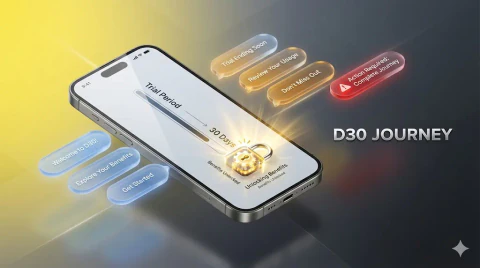
Fig. 01 — LazyPay D30 New User Journey
Designing a multi-channel communications strategy to convert trial users into KYC-verified customers within a 30-day window
Overview
LazyPay operates a Buy Now Pay Later (BNPL) model where new users get a trial period to transact before completing a mandatory KYC (Know Your Customer) process. The D30 program extended this trial window from 15 days to 30 days — giving users more time to experience the product while maintaining regulatory compliance. The core challenge was designing a communications strategy that would convert trial users into fully KYC-verified customers before their window expired, without being intrusive or damaging trust.
This case study documents the end-to-end communications architecture — from tone calibration and channel orchestration to phased rollout planning and event tracking — that powered this initiative across new and existing users.
The Challenge
RBI regulations mandate full KYC for BNPL products. Users who don't complete KYC within the trial period get their transactions blocked. The previous 15-day window resulted in low KYC conversion rates because users didn't have enough time to build product affinity before being asked to verify their identity. The D30 program aimed to solve this by:
- Extending the trial period to 30 days to build product stickiness
- Designing a progressive communication system that escalates urgency over time
- Maintaining repayment rates and controlling financial risk (dollar-risk) during rollout
- Supporting both new user onboarding and existing user migration paths
Communication Tone Architecture
The strategy introduced a three-tier tone system that maps directly to where a user sits in their trial lifecycle. This was the backbone of every message across every channel.
Soft Tone — Days 0 to 8
Used when the trial has more than 10 days remaining. Messages focus on welcoming the user, showcasing product benefits, and gently nudging toward KYC as an enabler of premium features like higher limits, 30-day billing, and utility bill payments.
The framing here is aspirational — KYC is positioned as an upgrade, not a requirement.
Medium Tone — Days 9 to 12
Triggered when the trial has 10 or fewer days remaining. Messages shift to urgency — countdown language, warnings about blocked transactions, and social proof (10+ lakh customers have completed KYC). The framing moves from "unlock benefits" to "don't lose access."
Hard Tone — Post Trial Expiry
Activated after the trial ends and transactions are blocked. Messages are direct — "Your transactions are blocked. Complete KYC to unblock." No softening, no benefit framing. Pure action-oriented recovery messaging.
Channel Strategy
Messages were delivered through three channels, each with a distinct role and fallback logic.
Push Notifications
Short, emoji-rich nudges designed for glanceable engagement. Used as the lightest-touch channel. Examples across tones:
- Soft (D1): "Welcome to your LazyPay trial — Want the full experience? Get a chance to unlock benefits like higher limit, 30-day billing and utility bill payments!"
- Medium (D5 before expiry): "Time is running out! Your trial period ends in 5 days. Finish your KYC to continue transacting with LazyPay."
- Hard (Post-expiry): "Your transactions are blocked — Complete a 2-min KYC to unblock your transactions."
The richest channel — used for detailed, formatted messages with bullet points, bold text, and CTAs. WhatsApp served as the primary conversion driver because of its high open rates and ability to carry structured content.
Each WhatsApp message included a CTA button (e.g., "Complete KYC" or "Launch LazyPay App") and was designed to address specific objections at each stage — security concerns, time investment, and benefit clarity.
SMS (Fallback)
SMS activated only when WhatsApp delivery failed. Messages were compressed versions of the WhatsApp content, limited to 160 characters where possible, with deep links to KYC flows or app download.
Communication Timeline
The 30-day journey was divided into distinct communication windows with a deliberate "No Comms" period during the pre-statement and repayment windows to avoid message fatigue and conflicts with transactional notifications.
| Phase | Days | Tone | Channels Active | Key Message Theme |
|---|---|---|---|---|
| Welcome and Onboarding | D0–D2 | Soft | WA, Push | Product education, benefit framing |
| Benefit Nudges | D3–D8 | Soft | WA, Push, SMS | KYC as upgrade, social proof |
| Urgency Ramp | D9–D12 | Medium | WA, Push, SMS | Countdown, access warnings |
| Pre-Statement Window | D13–D15 | None | — | No comms (repayment period) |
| Final Push | D16–D18 | Medium | WA, Push, SMS | Last chance, blocking warnings |
| Post-Expiry Recovery | D19+ | Hard | WA, Push, SMS | Blocked state, unblock CTA |
The "No Comms" periods were critical design decisions. Sending KYC nudges while a user is also receiving repayment reminders would create cognitive overload and dilute both messages.
Phased Rollout Architecture
The rollout followed a carefully gated progression, with each phase requiring specific metrics to pass before expanding.
New Users
- CUG (1%) — May 28–30: Bug detection, configurability testing, whitelisting mechanism validation
- 5% Rollout — June 4: A/B analysis on repayment rate vs. control (95%), dollar-risk monitoring, bug triage
- 20% Rollout — July 10: KYC conversion benchmarking (target above 60%), M1/M2 retention tracking, MITC completion rates
- 50% Rollout — Aug 10: Guard metrics validation
- 100% Rollout — Aug 21: Full production
Existing Users
Existing users followed a parallel but delayed schedule starting June 4 with CUG, reaching 100% by September 10. This stagger allowed the team to apply learnings from new user cohorts before exposing the existing base.
Escalation Playbooks
Each rollout phase had pre-defined escalation paths:
- Low repayment rate: Deterrent comms A/B test, manual calling activity
- High dollar-risk: Policy review, BRE (Business Rule Engine) check, merchant-level analysis
- Low KYC conversion (under 60%): User research on top motivators, focused D30 flow interviews, comms revision
- Low MITC conversion (under 35%): Introduce offers, frequency revision, user research on motivators
Event Tracking and Analytics
The communications system was instrumented with a comprehensive event tracking framework to measure every touchpoint.
Core Events
bnpl_sale_transaction— Triggered on first BNPL transaction (txn_no: 1), used to segment users who have product experienceuser_state— Central event carrying d30_flag, trial_period_left, kyc_state, mitc_state, user_type, user_status (converted/pending/blocked)repayment_status— Signals repayment period on/off to suppress comms during statement windows
KYC Funnel Events
Every step of the KYC flow was tracked with D30-specific properties appended:
screen_viewed— KYC mode selection, stepper screen, PAN form, profile page, review screenclick— All CTAs (back, proceed, submit, do_it_later) with page contextkyc_form_page_load/kyc_form_input_submit/kyc_form_page_submit— Form interaction granularityselfie_sdk/selfie_click/face_match_decision— Biometric verification trackingdigio_response/digio_event— Aadhaar OTP flow instrumentationHyperverge_Video_Call/Hyperverge_VKYC_Status— Video KYC scheduling and completion
All events carried D30-specific properties: d30_flag, trial_period_left, trial_cycles_defined, user_type, and Onboarding_flow: D-30 — enabling isolated analysis of the D30 cohort.
In-App Widget Tracking
Home screen widgets (hero banners, drop-off banners) were tracked for load and click events with widget_type, Widget_State (VKYC_Schedule, VKYC_Result), and widget_position — enabling optimization of in-app real estate for KYC conversion.
Behavioral Design Decisions
Progressive Disclosure of Urgency
The tone system wasn't just about copy — it was a behavioral architecture. Users in the soft phase saw KYC framed as optional-but-rewarding. Only as the deadline approached did messaging shift to loss-aversion framing ("don't lose access"). This mirrors the endowed progress effect — users who've already transacted feel ownership and are more motivated to protect their access.
Social Proof Calibration
WhatsApp messages in the soft and medium phases included specific social proof: "10+ lakh customers have already completed KYC." This wasn't generic — it was calibrated to LazyPay's actual verified user base and placed strategically in messages where users might hesitate about data security.
Channel-Specific Copy Architecture
Each channel had purpose-built copy, not repurposed content:
- Push: Emoji-first, single-line hooks, glanceable
- WhatsApp: Structured with bold headers, bullet lists, shield/lock emojis for trust signals, explicit CTA buttons
- SMS: Compressed, link-first, no formatting — designed for the lowest-common-denominator delivery
Repayment Window Blackouts
Comms were deliberately paused during pre-statement and repayment windows. This was a cross-functional decision involving product, collections, and marketing teams to prevent overlap with collections comms for delinquent users.
Cross-Functional Coordination
The D30 comms strategy required alignment across multiple teams:
- Collections team: Check overlap with collections comms for 1st-cycle delinquent users
- Xpress marketing team: Prevent overlap with Xpress product marketing comms
- Engineering: Add web repayment touchpoints, implement merchant checkout failure comms
- Business/Modelling team: Rewards whitelisting and amount configuration (awaiting model input at 5% rollout)
Key Metrics Framework
| Metric | Type | Target | Action if Missed |
|---|---|---|---|
| Repayment Rate | Primary | Under 5% delinquency | Deterrent comms, manual calling |
| Dollar-Risk | Primary | Under x% threshold | Policy/BRE review, merchant analysis |
| KYC Conversion | Primary | Above 60% | User research, comms revision, flow interviews |
| MITC Completion | Secondary | Above 35% | Offers introduction, frequency revision |
| M1/M2 Retention | Secondary | Benchmark | Engagement loop redesign |
| Bug-Free Experience | Gate | Zero P0/P1 | Ticket triage, priority resolution |
Scenario Planning
The communications system was designed to handle multiple user journey permutations. Users could start their trial on any calendar day, meaning the tone phases would overlap differently with repayment windows. The team mapped out 10+ scenario variants to ensure that:
- No user receives soft-tone messages after their trial expires
- Medium-tone messages never overlap with repayment window comms
- Hard-tone messages activate immediately upon trial expiry regardless of calendar position
- The "No Comms" blackout always takes precedence during repayment periods
Impact and Learnings
What Worked
- The three-tier tone system created a natural urgency gradient that respected user psychology
- WhatsApp as the primary channel drove the highest engagement due to rich formatting and high open rates
- Phased rollout with explicit guard metrics prevented premature scaling and protected financial risk
- Comprehensive event tracking enabled rapid iteration on copy, timing, and channel mix
What I Would Do Differently
- Earlier integration of rewards/incentives (delayed due to business model dependencies)
- A/B testing on message frequency within the soft phase — the current cadence was hypothesis-driven
- Deeper personalization based on transaction behavior (e.g., high-frequency transactors get different messaging than one-time users)
My Role
As Sr Director of Design at LazyPay / PayU Credit, I led the communications design strategy end-to-end — from defining the tone architecture and channel strategy to coordinating cross-functional rollout planning. I worked closely with product management, engineering, business analytics, and the collections team to ensure the comms framework was both user-centric and commercially sound. The event tracking specification was co-authored with the analytics team to ensure every design decision could be measured and iterated on.